$1M+
Lost per household in hidden fees over a 30‑year career
40%
Of retirement funds consumed by taxes & fees on average
100%
Client education‑focused approach
From wealth management to private real estate contracts, we provide a full spectrum of services to protect, grow, and transfer your assets.
Wealth Management
Holistic portfolio strategies designed to protect and grow your assets against inflation, market volatility, and unnecessary taxation — with full transparency.
Retirement Planning
Customized retirement roadmaps that expose and eliminate hidden traps including excessive fees, tax bombs, and sequence-of-return risk before they derail your future.
Debt Services
Strategic debt restructuring and elimination programs that free capital to be redirected into wealth-building vehicles — accelerating your path to financial freedom.
Annuities
Tax-advantaged annuity solutions offering guaranteed income streams, downside protection, and growth potential — creating certainty in an uncertain market.
Life Insurance Solutions
Beyond death benefits — properly structured life insurance serves as a private banking system, tax shelter, and generational wealth transfer vehicle.
Private Real Estate Contracts
Exclusive private contract real estate investment opportunities providing consistent returns outside of traditional market volatility with asset-backed security.
Hidden Fees & Expense Ratios
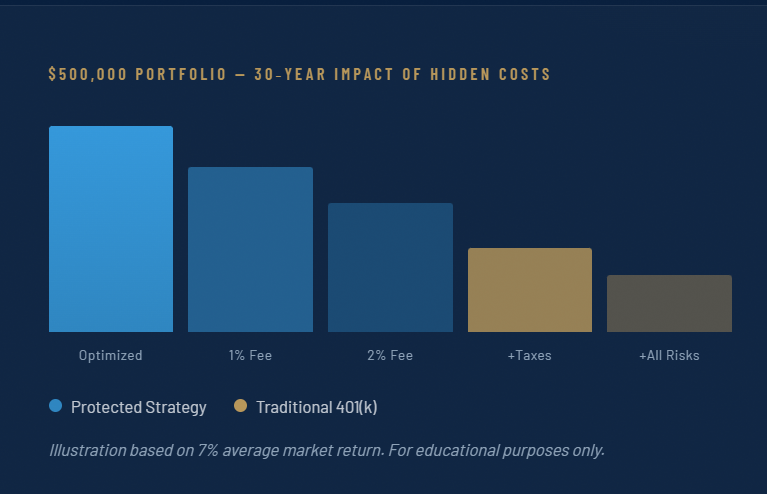
A 1% annual fee difference can cost you over $500,000 over 30 years. Most investors have no idea what they’re actually paying — and their advisors won’t volunteer the information.
The Tax Time Bomb
A 1% annual fee difference can cost you over $500,000 over 30 years. Most investors have no idea what they’re actually paying — and their advisors won’t volunteer the information.
Hidden Fees & Expense Ratios
Traditional 401(k)s defer taxes — they don’t eliminate them. When you retire, every dollar you withdraw is taxed as ordinary income, often at higher rates than expected.
Market Volatility & Emotional Decisions
Market swings are inevitable — but panic withdrawals and poorly timed rebalancing permanently lock in losses, destroying decades of compound growth in a single correction.
Sequence of Returns Risk
A major market downturn in the first 5 years of retirement can be catastrophic. Even if markets recover, the damage done to a withdrawal portfolio can be permanent.
Average vs. Actual Rate of Return
A fund “averaging” 10% doesn’t mean you earn 10%. Volatility drag means your actual return is always lower — this math gap can reduce your nest egg by 20–30% over time.
“The average American loses over 40 cents of every retirement dollar to fees and taxes — without ever knowing it happened.”
Legacy Assurance Group — Client Education Series
The Department of Labor estimates that a 1% fee difference on a $100,000 account over 35 years reduces your ending balance by 28%. On a $500,000 account, that's over $140,000 vanished to fees you likely never noticed. A 1% annual fee difference reduces a $100K account by 28% over 35 years — per the U.S. Dept. of Labor. Fund expense ratios, admin fees, 12b-1 marketing fees, advisor fees, and trading costs often combine to 2–3% annually — erasing real returns. The median American worker loses approximately $155,000 in retirement savings to 401(k) fees over their working career. Properly structured insurance products and alternative investments can eliminate many traditional fee layers while maintaining growth potential.The True Cost of Hidden Fees in Retirement Plans
28%
Balance Reduction
Layers of Hidden Charges
$155K
Average Hidden Fee Cost
Fee-Free Alternatives Exists
Social Security benefits become 85% taxable. Medicare premiums increase with income. Your 401(k) RMDs at 73 could push you into a higher bracket — with no ability to control the timing or amount. Up to 85% of your Social Security benefit can be subject to federal income tax — directly triggered by other retirement income sources. Required Minimum Distributions at age 73 force withdrawals whether you need them or not — creating taxable events you cannot control or avoid. Properly structured Indexed Universal Life policies provide tax-free retirement income via policy loans — not counted in RMD calculations. The U.S. national debt now exceeds $34 trillion. Betting your retirement on low future tax rates is a significant and often unacknowledged risk.The Retirement Tax Bomb: Defusing It Before It Explodes
85%
Social Security Taxable
RMD Tax Trap
0%
Tax on IUL Income
Future Tax Rates Unknown
Market volatility creates two distinct problems: mathematical losses that are asymmetric, and emotional decisions that lock in those losses permanently. Both are predictable — and both can be mitigated with the right structure. Asymmetric loss math means a 50% decline requires a 100% gain just to return to breakeven — costing you irreplaceable compounding time. The S&P 500 has experienced over 10 major corrections since 1980 — each one a potential retirement destroyer for those without downside protection. Index-linked products with 0% floors protect against down years entirely — giving compound growth an uninterrupted foundation. Research shows average investors underperform the index by 1.5–4% annually due to emotional buy/sell decisions driven by market fear and greed.Market Volatility: Why Your Portfolio Can't Afford to Lose
-50%
Needs 100% to Recover
10+ Corrections Since 1980
Floor=%
Indexed Product Protection
Behavioral Finance Costs
A 2008-style correction in year 2 of your retirement could permanently exhaust your portfolio by year 15 — even if markets fully recover afterward. The damage from forced selling at a loss during withdrawals is irreversible. Identical portfolios, identical average returns — one retires in a bull market, one in a bear market. The difference: running out of money 15 years early. The 5 years before and 5 years after retirement are the most financially vulnerable of your life. A major loss here is nearly impossible to fully recover from via withdrawals. Income segmentation — holding 2–5 years of expenses in stable, guaranteed accounts — allows equity portfolios to recover without forced sales during downturns. Annuities and properly structured life insurance create income that never stops regardless of market performance — eliminating sequence risk for essential expensesSequence of Returns Risk: The Retirement Killer Nobody Mentions
The "Lucky" vs "Unlucky" Retiree
10 Yrs
Critical Review
Bucket Strategy Solution
Guaranteed Income Floors
This gap can cost you 15–25% of your final portfolio value — and financial institutions use this confusion every single day to make their products look better than they perform. Actual Return = Average Return − (Variance ÷ 2). Even modest volatility dramatically reduces your real compounded growth over time. Higher volatility = larger drag. Gaining 50% then losing 50% gives an average of 0% — but your $100,000 becomes $75,000. That 25% loss is permanent and invisible in the "average." Prospectus marketing and performance reports nearly always display arithmetic average returns — not the compound actual returns investors truly experience. Annuities and properly structured life insurance create income that never stops regardless of market performance — eliminating sequence risk for essential expensesAverage Rate of Return vs. Actual Rate of Return
The Volatility Drag Formula Retiree
-25%
+50% then -50% = -25% Real
How Advisors Use This Against You
Zero Floor
Eliminating Volatility Drag
Our underperforming asset repair process begins with a comprehensive audit: what do you have, what is it actually earning net of fees and taxes, and what should it be doing based on your goals? IRS Section 1035 allows tax-free exchanges from old, underperforming insurance or annuity contracts into new, more efficient products — no taxable event triggered. With inflation averaging 3–4%, CDs earning 2–3% create a guaranteed real loss. "Safe" money losing to inflation is an underperforming asset in disguise. Properly funded Indexed Universal Life can outperform traditional savings by 3× or more on a net, after-tax basis over a 20-year period. Existing life insurance policies can often be restructured, exchanged, or supplemented to dramatically improve performance without losing existing basis.Repairing Underperforming Assets: Turning Liabilities Into Engines
1035 Tax-Free Exchanges
CD and Money Market Risk
3×
IUL vs. Savings Account
Policy Rescue Program
Banking Truth #1
Banks Never Risk Their Own Money — Neither Should You
Banks borrow money at 2–3% and lend it at 6–8%, capturing the spread risk-free. They keep their capital in protected, guaranteed instruments. The secret isn’t high-risk investing — it’s controlling the banking function itself through properly structured financial vehicles that replicate what banks do for themselves.
Banking Truth #2
You Finance Everything You Buy — One Way or Another
When you pay cash, you lose the future growth of that capital. When you borrow, you pay interest. Either way, you’re financing the purchase. The key: when you use properly structured policy loans, you can pay for purchases while your account continues earning — recapturing the financing cost entirely.
Banking Truth #3
Compound Interest Works Differently for Banks
Banks compound interest in their favor daily on loans you owe them — while paying you monthly or quarterly on deposits you’re owed. The compounding frequency gap alone transfers massive wealth from consumers to the banking class. Understanding this asymmetry is the foundation of our client education program.
Banking Truth #4
The Wealthy Use Life Insurance as a Private Bank
High-net-worth individuals, major corporations, and banks themselves hold billions in cash value life insurance — not for the death benefit, but for tax-free accumulation, guaranteed growth, liquidity, and creditor protection. This strategy, known as “Infinite Banking,” is available to anyone who understands it.
Financial Discovery & Goal Mapping
Comprehensive review of your current assets, income needs, tax situation, and retirement timeline to design a customized income blueprint.
Pension Vehicle Selection
We select from fixed annuities, indexed annuities, structured insurance products, and real estate contracts to build income layers optimized for your profile.
Income Layering Strategy
Multiple guaranteed income sources are layered to cover essential expenses, discretionary spending, and legacy goals — ensuring no single point of failure.
Ongoing Education & Annual Review
Your plan is reviewed annually with updated education on tax law changes, market conditions, and new opportunities that may benefit your structure.
Personal Pension vs. Traditional 401(k)
Guaranteed Income for Life ✓ Personal Pension

We are a client-first financial education firm dedicated to exposing the hidden threats in conventional retirement planning and replacing them with transparent, protected, tax-efficient strategies built for long-term legacy.